Entry 01 / 16
CowSomeone, not something.
The industry calls them“Head of cattle”
Think of your best friend. When she's near, your body settles: you can feel it in your pulse.
The same happens to a cow. Next to her preferred companion, her heart rate and stress go down. She can live around twenty years, enjoys the morning sun and chooses whom to graze with.
The dairy industry makes her pregnant again and again so she keeps producing, and her calf is taken within hours or days. Then she calls for it. For hours. Sometimes for days.
The meat industry exploits her too, and in Chile young cattle end up in rodeo.
A head of cattle gets counted. Someone gets missed.
Sources: McLennan, Univ. of Northampton (2013); EFSA (2023)
Entry 02 / 16
PigSomeone, not something.
The industry calls them“Live weight”
In one study, some pigs learned to use information from a mirror to find food hidden behind a barrier.
Pigs have also learned to move a joystick with their snout to play a simple video game. And when a mother nurses, she grunts softly to her piglets in a steady rhythm, like a song.
The meat industry calls him “live meat”. Many mothers spend their lives in crates where they cannot turn around, and their piglets are fattened to be killed a few months later.
A life of their own, far beyond what others gain from it.
Sources: Broom et al., Animal Behaviour (2009); Croney & Boysen, Frontiers in Psychology (2021)
About the mirror study
Broom and colleagues (2009) observed pigs using reflected information to find food. This does not establish self-recognition; a later replication attempt found different results. These findings need to be read in context.
Original study · Replication study
Entry 03 / 16
HenSomeone, not something.
The industry calls them“Layer”
Before her chicks break out of the shell, she is already talking to them.
She has more than twenty distinct calls. One warns of danger from the air; another, of danger on the ground. And when her chicks are stressed, her heart speeds up too.
The egg industry bred her to lay close to 300 eggs a year. She usually lives in cages or overcrowded sheds, and her brothers are killed at birth because they don't lay eggs.
What she loves most is a dust bath in the sun.
“Layer” says what the industry wants from her. It doesn't say who she is.
Sources: Marino, Animal Cognition (2017); Edgar et al., Proc. R. Soc. B (2011)
Entry 04 / 16
SalmonSomeone, not something.
The industry calls them“Biomass”
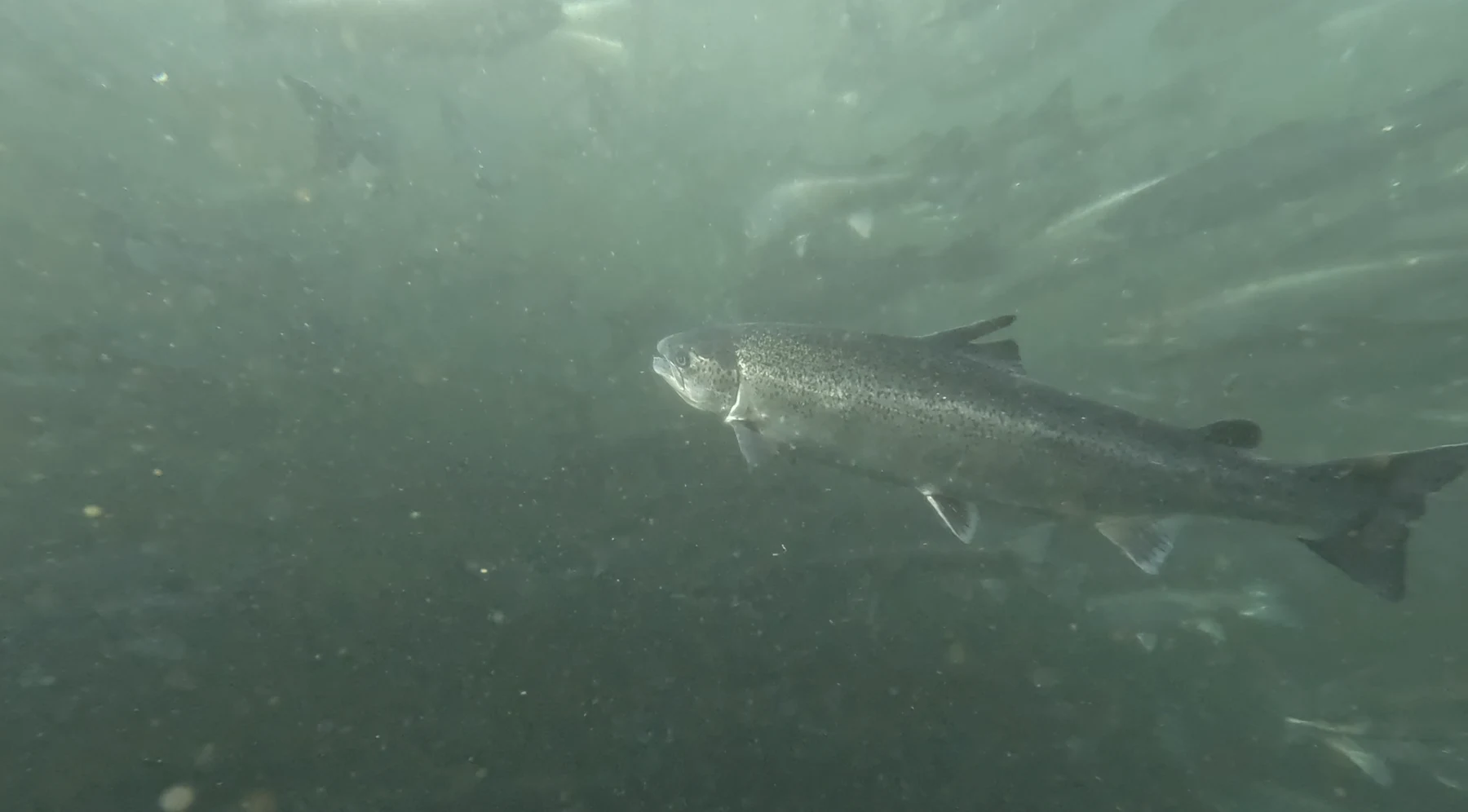
He is born in a river. He swims down to the sea, travels thousands of kilometres and returns, guided by smell, to the very river where he was born.
Fish have pain receptors and change their behaviour in response to harmful stimuli. They feel.
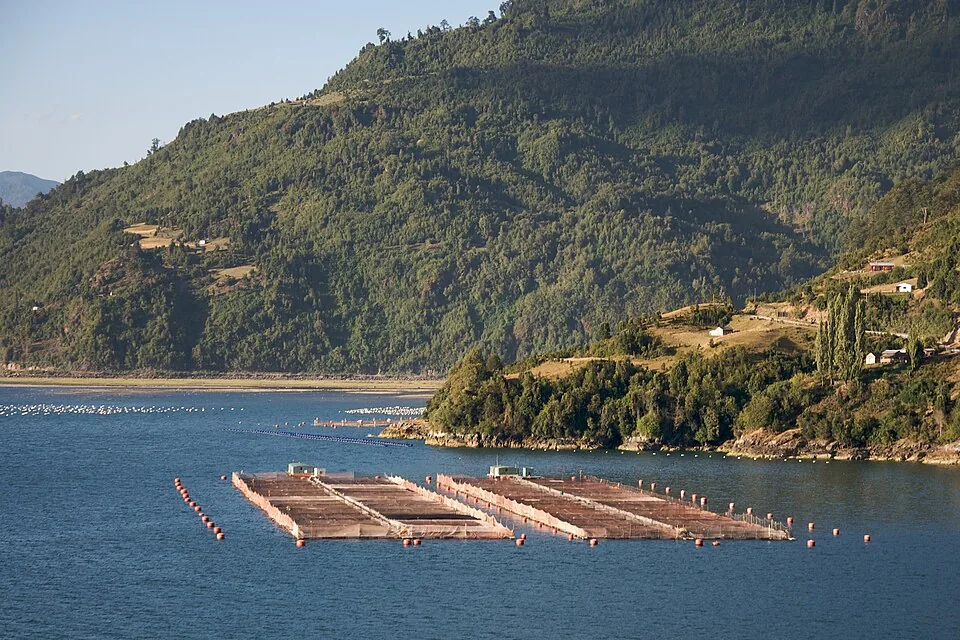
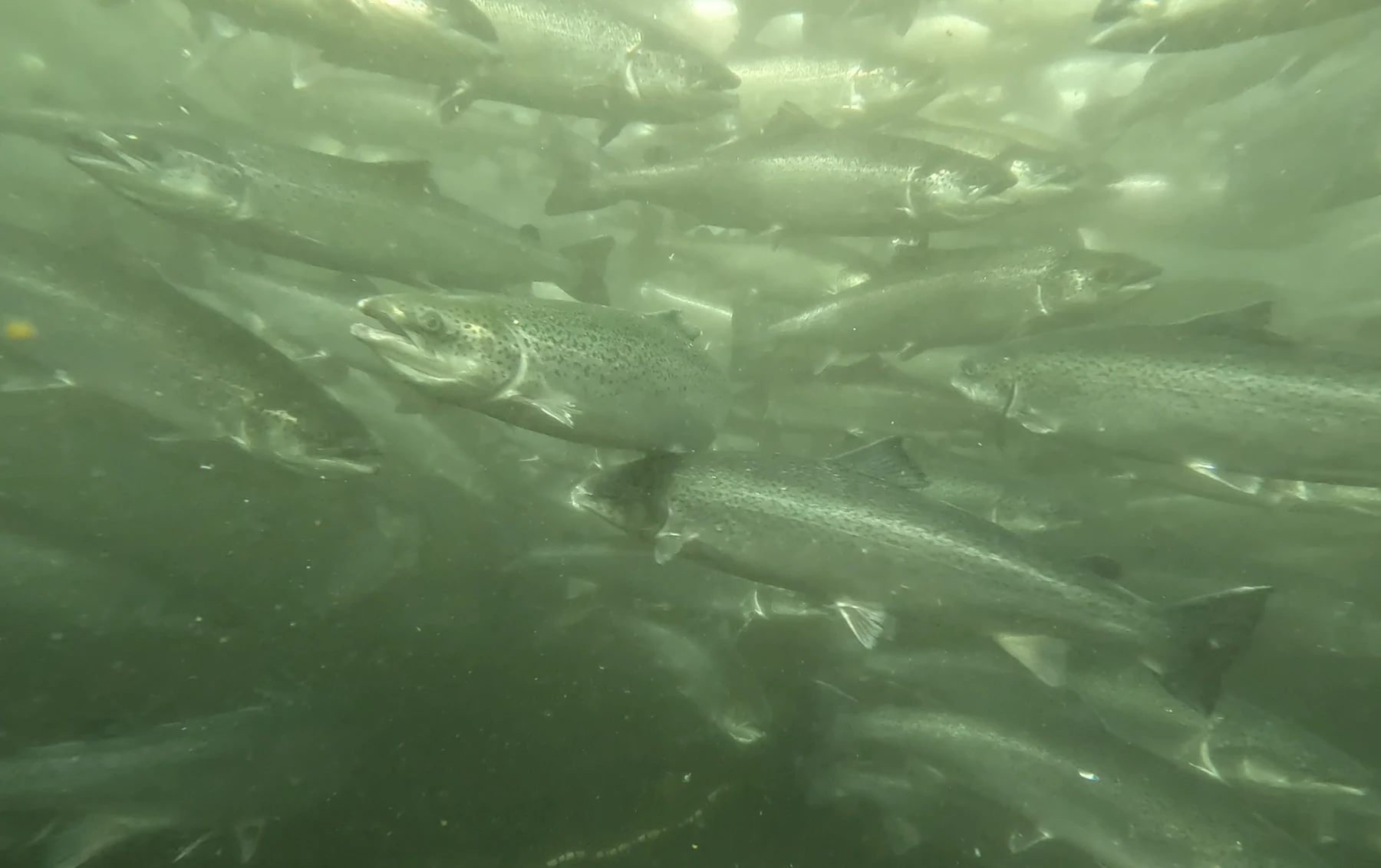
Chile is the world's second-largest salmon producer. Millions of fish live in high-density sea cages, with parasites, disease and mass die-offs. None of them will make that journey.
The industry doesn't count him: it weighs him. But every tonne is made of individuals.
Sources: Sneddon et al., Proc. R. Soc. B (2003); Seafood Watch
Entry 05 / 16
GreyhoundSomeone, not something.
The industry calls them“Racing stock”
He is one of the fastest dogs in the world. And at home, one of the calmest.
When a dog and their human look into each other's eyes, oxytocin, the bonding hormone, rises in both. He also tells emotions apart in our faces and voices.
In Chile there are an estimated 300 racetracks, most of them unregulated. There his speed becomes a bet, and when he stops winning, he is often abandoned.
He runs for play and for joy. Never for a bet.
Sources: Nagasawa et al., Science (2015); Albuquerque et al., Biology Letters (2016); The Clinic (2024)
Entry 06 / 16
AlitaSomeone, not something.
Hunters call them“Game”, “trophy”
Every year she flies thousands of kilometres. And when she returns, she often looks for the same nest.
Pairs raise their chicks together and feed them hundreds of times a day. She drinks in mid-flight, skimming the water.
Alita stands for all wild birds: those hunted for sport, those captured to be sold in cages and those losing their homes to deforestation and pesticides.
We chose her as our symbol: freedom in motion.
Sources: BirdLife International
Entry 07 / 16
CatSomeone, not something.
Many call them“Stray”
Among many voices, he recognizes the one of the person who cares for him. And he tells his own name apart from other words.
If he looks at you and blinks slowly, he is telling you he trusts you.
Millions live on the streets for lack of sterilization and responsible care, exposed to abandonment and abuse.
“Stray” says where he lives. It doesn't say who he is.
Sources: Saito & Shinozuka, Animal Cognition (2013); Saito et al., Scientific Reports (2019); Humphrey et al., Scientific Reports (2020)
Entry 08 / 16
BeeSomeone, not something.
The industry calls them“Productive hive”
She finds a field of flowers and flies back to the hive with the news. She tells it by dancing: the dance shows distance and direction.
She can learn to recognize a human face and remember it days later. And her relatives, bumblebees, roll little balls without getting anything in return. They play.
Pesticides and the loss of wildflowers threaten her. Intensive beekeeping moves her from place to place and takes her food to sell honey.
A hive is not a factory. It is thousands of individuals who dance, learn and play.
Sources: von Frisch (Nobel 1973); Dona et al., Animal Behaviour (2022); Dyer et al., Journal of Experimental Biology (2005)
Entry 09 / 16
RabbitSomeone, not something.
The industry calls them“Lab animal”
When he's happy, he jumps and twists in the air. That jump has a name: a binky.
He is very social: he grooms his companions and suffers when alone. He can live more than ten years and recognize the people who care for him.
He is one of the animals most used to test cosmetics and chemicals. The meat and fur industries exploit him too.
There is no room for a binky in a laboratory cage.
Sources: Humane Society International; RSPCA
Entry 10 / 16
FoxSomeone, not something.
The industry calls them“Pelt”
He plays. Alone and in groups, even as an adult.
Mother and father raise their cubs together. And he seems to orient himself by the Earth's magnetic field, as if he carried a compass inside.
On fur farms he spends his life in wire cages until he is killed for his coat.
His fur already has an owner: him.
Sources: Červený et al., Biology Letters (2011)
Entry 11 / 16
Sea turtleSomeone, not something.
The industry calls them“Bycatch”
She can live more than fifty years. She thinks in decades.
When the time comes, she returns to lay her eggs on the beach where she hatched, guided by the Earth's magnetic field. Science recognizes a realistic possibility of conscious experience in reptiles.
Industrial fishing traps her in nets and on hooks. And at sea she mistakes plastic for food.
For the industry, an accident. For her, the only life she had.
Sources: Andrews et al., New York Declaration on Animal Consciousness (2024); Brothers & Lohmann, Current Biology (2015)
Entry 12 / 16
DogSomeone, not something.
Breeders call them“Breeding stock”
When he sees someone he loves, he wags his tail more to the right.
He reads our emotions in our faces and voices at the same time. And when he looks into our eyes, his oxytocin rises, just like ours.
The puppy trade turns him into merchandise. Many end up on the streets once they are no longer puppies, and others on racetracks.
A specimen gets sold. Someone gets cared for.
Sources: Albuquerque et al., Biology Letters (2016); Nagasawa et al., Science (2015); Quaranta et al., Current Biology (2007)
Entry 13 / 16
OwlSomeone, not something.
Superstition calls him“Bad omen”
He flies almost silently. He turns his head up to 270 degrees and can find his way in total darkness by hearing alone.
His world is made of sounds we cannot perceive. And, like other birds, he has the neurological structures associated with conscious experience.
Poisons spread across the countryside reach him. Habitat loss and road traffic threaten him too.
He doesn't bring bad luck. We bring it to him.
Sources: Low et al., Cambridge Declaration on Consciousness (2012); Payne, Journal of Experimental Biology (1971); Konishi, Scientific American (1973); The Barn Owl Trust
Entry 14 / 16
SheepSomeone, not something.
The industry calls them“Wool stock”
She recognizes around fifty faces of other sheep and remembers them for two years.
She can also learn to recognize human faces in photographs. And when she is stressed, seeing the face of a companion calms her.
The wool and meat industries shear her at production pace and kill her when she stops yielding.
She never forgets a face. The industry never looks at hers.
Sources: Kendrick et al., Nature (2001); Knolle et al., Royal Society Open Science (2017); da Costa et al., Proc. R. Soc. B (2004)
Entry 15 / 16
DuckSomeone, not something.
The industry calls them“Fattening fowl”
Just out of the egg, he already understands the concepts of same and different.
He bonds with whoever he sees when he hatches and follows them everywhere. He needs water not only to swim, but also to clean himself and to be well.
For foie gras he is force-fed through a tube. The down industry exploits him too.
He was born able to tell things apart. He deserves to be told apart.
Sources: Martinho & Kacelnik, Science (2016); Lorenz (1935)
Entry 16 / 16
OctopusSomeone, not something.
The industry calls them“Seafood”
He has three hearts and some 500 million neurons, most of them in his arms. He changes colour and texture in an instant.
He opens jars, uses coconut shells as shelter and tells some people apart from others. When he is hurt, he tends the wound and avoids returning to where it hurt.
Fishing pulls him from the sea by the millions. And there are plans for industrial farms that would lock a solitary, curious animal in tanks.
For the industry, seafood. For science, one of the most astonishing minds in the ocean.
Sources: Birch et al., London School of Economics (2021); Crook, Current Biology (2021); Finn et al., Current Biology (2009); Godfrey-Smith, Other Minds (2016)